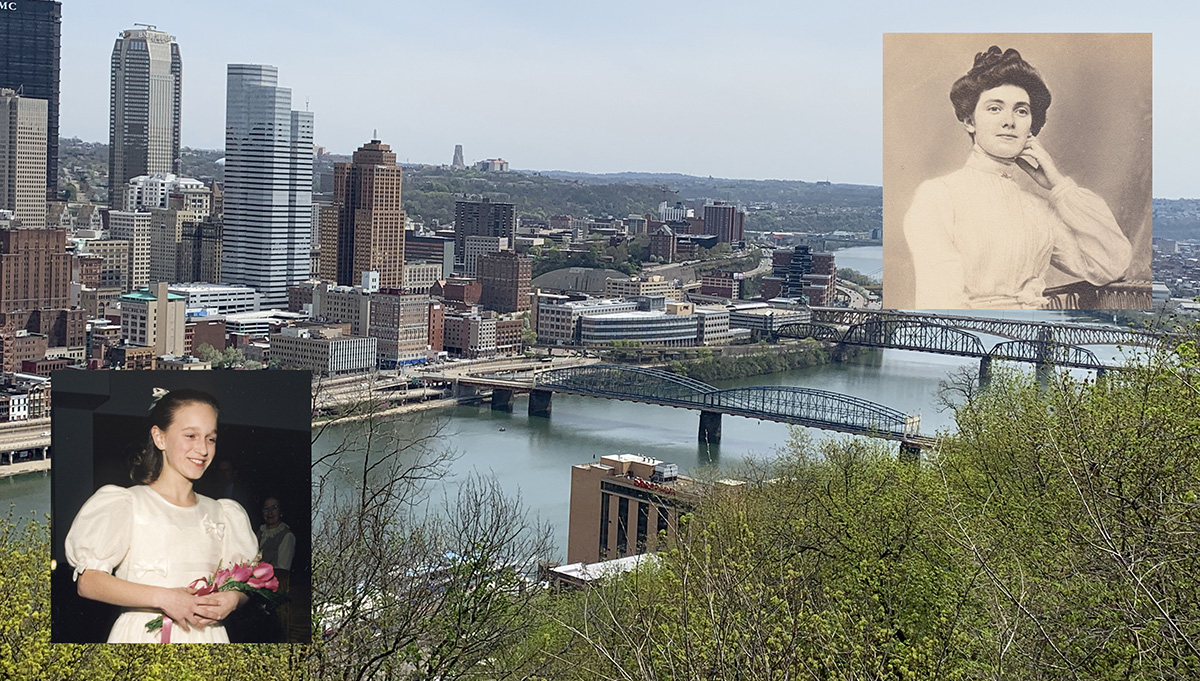
Last month we went to Pittsburgh to visit my stepdaughter Katie and her husband Dave. They moved to the ‘Burgh during the pandemic, and we hadn’t seen them for more than a year. It was a sweet reunion with lots of smiles and happy discoveries. We loved seeing their new home and walking through the neighborhood. It was easy to imagine all the wonderful things their life there will bring.
One hundred years ago my father was growing up in Mt. Washington, a short drive from Katie and Dave’s house in Mt. Lebanon. On our second day in town, they took us to see the house where my father grew up. When we stopped in front of the house and looked up the steep hill it sat upon, Dave said, It was probably much nicer when your dad was growing up. Dave is a very diplomatic guy, a kind man. I don’t think so, Dave, I replied. This was a ghetto.
The city was very different then, filled with steel mills, coal smoke, and new immigrants: Italian, Polish, German, and, of course, Irish. My grandparents, Peter Reilly and Annie O’Connor grew up less than five miles from each other in County Galway, a beautiful, stone-strewn landscape of peat bogs, lakes, and mountains. They both left family they loved dearly to seek opportunity in America at the turn of the 20th century. They both ended up in Pittsburgh.
When I was very young, my father told us about the moment Peter first saw Annie. He stood on the sidewalk as she rode by in a streetcar. My dad, who would have been a small child at the time, recalls his father telling him that “my heart fair leapt in my throat.” He said that from that moment his prayer was to marry her.
Peter had been well educated in Ireland and hoped to receive a teaching position. But when no offer came, his family convinced him to emigrate. They never told him that his offer to teach had come in the next day’s mail. When my dad went to Ireland in 1976, he visited his father’s only living sister, Aunt Honora, who remembered watching her brother walk down the lane in Moycullen, leaving for America. She said his little dog chased after him as everyone watched him go, knowing they would never see him again.
Annie was the oldest in her family. Her father was a game warden on a large estate called Rosscahill as his father before him had been. On his deathbed, Annie’s father made her promise to go to America to find a better life. When she arrived in Pittsburgh, she got a job working as a companion and seamstress for Mary Thaw, the widow of the industrialist William Thaw. Primarily, Thaw had been one of the early investors and a major shareholder of the Pennsylvania Railroad.
Annie and Mrs. Thaw traveled through Europe together, but when Annie decided to marry Peter, she had to leave Mrs. Thaw’s employ. When Peter died, leaving Annie with five young children, Mrs. Thaw wanted them all to move to Elmhurst, the Thaw country estate, and said she would pay for their education, including college. But Annie declined, not wanting to take that sort of charity from anyone. Ten years after Peter died Annie became the first woman elected to the Pittsburgh City Council.
A force of nature, Annie disciplined her children rigorously. If James came home late, she would chase him through the house with a heavy glass bowl, the younger children behind her, begging their mother not to hurt him. She never did. Once James was in a tussle with my dad, who was a skinny guy, running through the house with Annie not far behind. She followed James into a bedroom and sat down on the bed which broke and fell to the floor. When she realized my dad was under the bed, she began to wail, thinking she had killed her fragile son.
My grandparents, who were native Irish speakers, were told that they should only speak English if they wanted to succeed in America. But on Tuesday evenings when my father was a little boy, a group of “Gaelic scholars” gathered in the Reilly parlor.
Dad and James sat on the stairs to listen, trying to understand this strange language, a language that was, in fact, their mother’s tongue. This was the time of the Easter Rising and the subsequent Civil War in Ireland. Those who gathered were undoubtedly part of the Gaelic Revival, and they talked in Irish of the politics and literature of the day, the two inextricably linked. My grandparents also took in men and women who had fled Ireland to America in order to avoid arrest by the English.
When John and I married, Katie was 10 and Maeve was 5. Maeve thought having a big sister was the coolest thing that had ever happened to her. Katie thought having Maeve and me in her family was pretty cool, too. But she and John had been a two-person team since she was only a year old. We were changing all that. Together we had to navigate this new family configuration. During our wedding vows, not only did John and I commit ourselves to one another but we committed to love, honor, and protect each other’s child.
There is one piece of advice I have since received about being a stepparent that I wish I had learned earlier. A wise friend said, You don’t have to do anything but love her. You didn’t have to give birth to her, and you don’t have to make sure she doesn’t talk with her mouth full. You don’t have to correct her when she misbehaves. That is someone else’s job. You only have to love her.
One Christmas we decided at the last minute to visit John’s parents in Florida. Airline tickets were so expensive to Miami at that point that I got us a compartment on the train. Our tiny room had two seats that turned into a bed and another bed that dropped down from wall. John and I shared one and the girls shared the other. There was a sink that covered a small toilet and a TV the size of a sheet of paper above the door to the corridor. We scrunched into our tiny compartment after hamburgers in the dining car to watch Men in Black.
After an uncomfortable night’s sleep, we woke to find that the train was six hours late. Katie and Maeve were not happy. And neither was shy about saying so. At about one that afternoon, I walked to the dining car to see about lunch. The servers were sitting at a table at the far end of the car. We’re not serving lunch. We were supposed to be in Miami by now. They were no happier than we were to be late. But I had kids who needed to eat. Can’t you grab something at one of our stops? Isn’t there a McDonald’s at any of the stations? I asked. They just shook their heads. Listen, if I don’t have something to feed my kids, I’m going to bring them down here to hang out with you, okay? Half an hour later, two happy meals magically appeared at the door of our compartment.
In America, Peter and Annie Reilly raised a brood of bright, enterprising children who were as different as humans could be, but they all became fiercely loving, loyal parents who instilled in their own children a strong sense of self, including a love of the land Annie and Peter left. When I stood in front of my grandparents’ gravesite, I was struck by all the love that first spark on a Pittsburgh street had engendered in countless souls.
Katie Brinkley Fitzgerald got a bachelors degree and a masters degree in social work. She now works at the VA with veterans who are struggling with everything from homelessness and chronic unemployment to PTSD. She gives them practical tools and guides them gently through difficult times. She’s a compassionate, beautiful young woman. And she will instill that same loyalty and love in her family that Annie O’Connor Reilly instilled in hers.
Note:
Annie Reilly’s name on the gravestone in Pittsburgh she shares with her husband Peter and their two sons who died as children is not Ann or Anne, but Annie. When I saw it, I realized that it’s much closer to her given name in Irish, Áine (pronounced Awn-yeh). Peter’s name was Peader (Pad-ur). Their last name would have been Ó Raghallaigh (Oh Rah-ha-lee). I would have so loved to speak to my grandparents in Irish. I wish I had asked my father and his siblings if their parents ever spoke to them in Irish. I’m nearly certain, though, that when they spoke of their love for each other, they spoke in Irish.
 Life of Reillys
Kate, I just LOVE reading your family stories. You are such a gifted writer, and your words flow along like a gentle, refreshing stream. I always look forward to the next installment ‘round the bend. 🙂
oxoxox Cathy
>
LikeLike
This one left me in tears. Loved it.
LikeLike
❤️ I miss you, Etta!
LikeLike
Kate-your stories are wonderful—thanks for sharing them! I had a quiet morning a few weeks ago to take a walk around the block on Jenifer and Jocelyn, and see lots of additions and renovations in progress. When we meet again, I will share my story of roads leading to Pittsburgh when my son, in
1992 had his heart set on seeing Guns and Roses and Metallica…after a near miss at RFK, we finally saw them in Pittsburgh! Definitely not the Beatles😉
LikeLike
Ann, I can’t wait to hear about your Guns and Roses road trip! And walking around the old neighborhood sounds like fun, too. ❤️
LikeLike
These stories are a great gift for Maeve, to know her family’s history. How sweet and lovely.
LikeLike
Thanks, Annie. That’s a big part of why I decided to start writing them. For Maeve and for all my nieces and nephews…and my cousins and their kids. It’s gotten to be a very large clan.
LikeLike
I loved reading this, Kate! Grandma lived the last few years of her life with my mom and dad in Syracuse. Unfortunately, my brothers Tom and John, and sister Mary Ann are the only ones to have memories of her. The downside of being the youngest :)!
In 2016, Boo and I went to Ireland and visited the Heritage Museum in Cork. The genealogist there found out that a Census taker had spelled her name wrong..they had her as “Anna” Reilly which was the reason why she wasn’t on any of the official Passenger Lists. He told us that she came over on the Servia (the first ship to have electricity) on September 26th, 1901. She was 23 years old when she arrived in New York. Then, he told us to turn around and behind him was a huge replica of the Sevia. It gave us the chills to actually see it – and a few tears as well! It was quite the visit! I’ll send some pictures to your email.
My youngest is legally named “Annie” Reilly McAuliffe…so there’s no confusion 🙂
Love to you and your family,
Patty
LikeLike
Patty, that’s a wonderful story! I was in Cork the year before you and Boo were there and now, of course, I will have to go back to see that replica of the ship our grandmother was on. Those of us too young to have memories of her will have to be satisfied with the photos, stories, and bits of knowledge we’ve learned about her life from museums. And good for you for naming your daughter Annie! Love, to you and your family, my cousin.
LikeLike
Thanks, Kate!
* The Heritage Museum was in Cobh, not Cork. Sorry…Can I blame it on the heat? 🙂
LikeLike
This is such a beautiful story, a Cháit
LikeLiked by 1 person
Go raibh míle maith agat, a Jennifer.
LikeLike